Previous lesson, division of attention.
Develop the pilot’s feel for varying control forces and the ability to plan and remain oriented while maneuvering the airplane with positive accurate control.
Today we are going to be putting out lines of forest fires precisely on short but staggered lines. When we drop the expensive retardant, we need to be at a precise altitude, airspeed, and heading so the retardant is effective and not wasted.
PTS: maintain coordinated flight throughout the maneuver, attain 30° bank at steepest point, and constant roll and pitch change throughout the turns. At each 180° rollout, +/- 100 ft altitude, +/- 10 kias entry airspeed, +/- 10° rollout heading.
Video: Lazy Eights Explained (3:10)
Preflight Briefing:
The maneuver consists of two 180° turns in opposite directions while making a climb and descent in a symmetrical pattern during each of the turns. Select a recover altitude no lower than 1,500 feet AGL, make clearing turns, radio calls, and configure in a clean configuration, 116 knots at a stabilized altitude. Stabilize the aircraft parallel to some roads or lines on the ground.
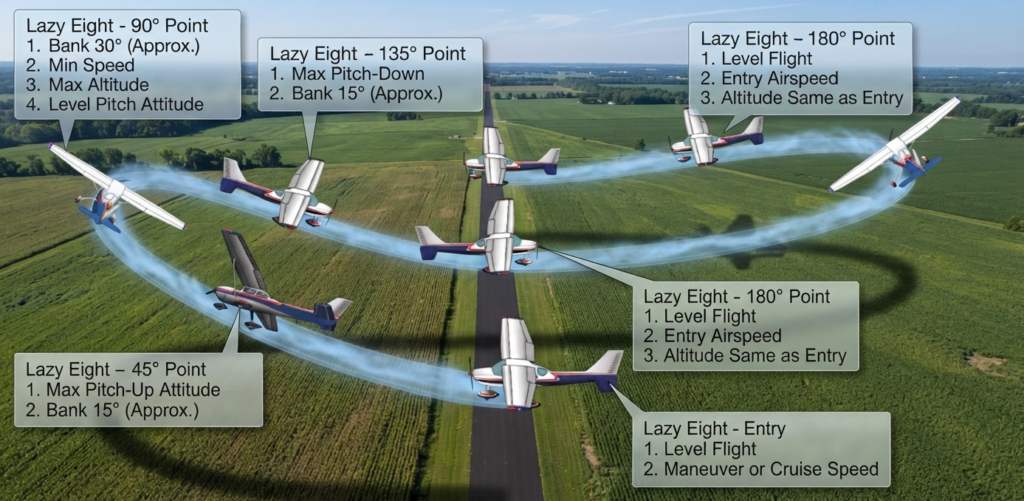
Click the diagram to enlarge. Reference: Airplane Flying Handbook, Ch. 10 — Performance Maneuvers, Fig. 10-4 (Lazy Eight)
Flight:
After clearing turns:
Pick visual references at 45° and 135° in the direction of the turns.
- Enter a coordinated climbing turn
- 45°: Max pitch up, 15° Bank (half)
- 90°: Max bank (30°), level pitch
- 135°: Max pitch down 15° bank (half)
- 180°: Level on airspeed and altitude
Common errors:
- Not clearing the area
- Maneuver not symmetrical across each 180°
- Inadequate or improper selection/use of 45°, 90°, and 135° references
- Ineffective planning
- Gain or loss of altitude at each 180° point
- Poor control at the top of each climb segment, allowing pitch to fall rapidly through the horizon
- Airspeed or bank angle standards not met
- Control roughness
- Poor flight control coordination
- Stalling at any point during the maneuver
- Execution of a steep turn instead of a climbing maneuver
- Not scanning for other traffic during the maneuver
- Performing by reference to the flight instruments rather than visual references
Special Emphasis Areas: Smoothness and accuracy through climbing and descending turns.
Divide attention between cockpit and outside.
Post-Flight Debriefing:
Identify tasks that were completed to standards or above.
Identify and discuss tasks that were not completed to standards.
Record and grade completed tasks in the training record.
Record training in the student’s logbook (reference Areas of Operation above)
Give an assignment for the next flight session.
Next Assignment: Prepare for completing this lesson by reviewing tasks that were not performed to standards. If all tasks were performed to standards, assign the next lesson’s required material.