Preflight Briefing:
Review the step by step procedure and how to compensate for wind.
Turns around a point (AFH 6-7/6-8)
- Purpose: to perfect the ability to subconsciously control the airplane while dividing attention between the flight path and ground references, to understand that the degree of bank used affects distance from point and ground track, to develop a keen perception of altitude, to perfect the ability to correct for wind drift while in turns, and to further perfect turning technique.
- Select a safe altitude
- Select a suitable ground reference point with consideration given to emergency landing areas
- Consider orientation, division of attention, and planning.
- Configure the aircraft and airspeed prior to entry
- Use proper entry procedure
- Correct for wind drift
- Maintain desired altitude, airspeed, and distance from reference point.
- Coordinate flight controls
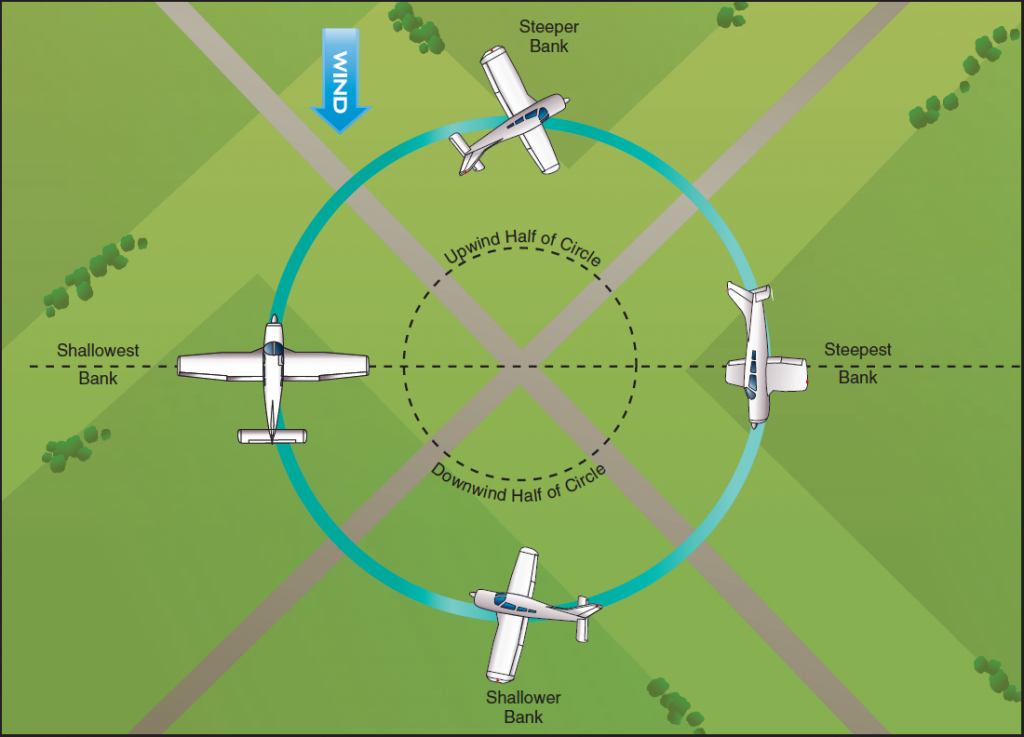
- Use a power setting enough to maintain altitude easily (clean configuration)
- Use no more than 45° of bank
- Pick a reference point of a clear 4 way road intersection (easiest reference)
- Enter downwind (with a tailwind) either side of the selected point
- Use shallowest bank going into the wind
- Use steepest bank going away from the wind
- Use a steeper bank on the upwind side than the downwind side
Common Errors
- Faulty entry procedure
- Poor planning, orientation, or division of attention
- Uncoordinated flight control application
- Improper correction for wind drift
- Failure to maintain selected altitude or airspeed
- Selection of a ground reference point where there is no suitable emergency landing are within gliding distance.
Complete clearing turns before every performance maneuver—usually at least 180° change in direction, looking for traffic (Jeppesen Private Pilot pg. 4-6)
Post-Flight Debriefing:
Identify tasks that were completed to standards or above.
Identify and discuss tasks that were not completed to standards.
Record and grade completed tasks in the training record
Record training in the student’s logbook (reference the Areas of Operation above).
Give an assignment for the next flight session.
Next Assignment: Prepare for completing this lesson by reviewing tasks that were not performed to standards. If all tasks were performed to standards, assign the next lesson’s required material.